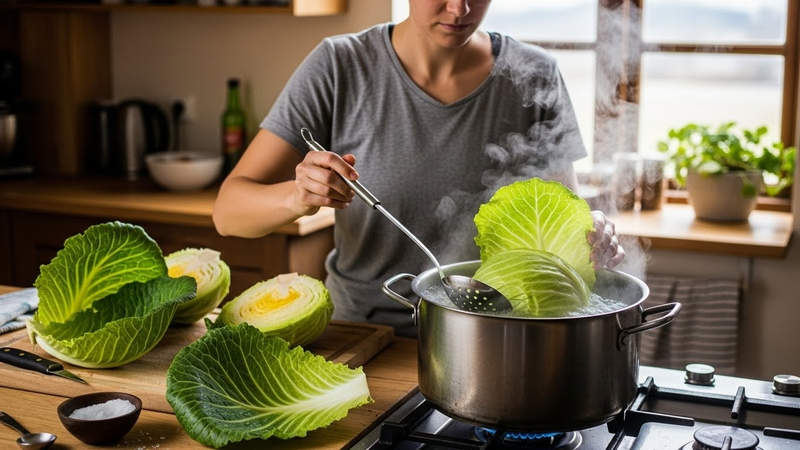
Why do some stuffed cabbage rolls fall apart, while others hold their tender filling in a supple embrace? The secret lies not just in the filling, but profoundly in the meticulous preparation of the cabbage leaves themselves. Achieving that ideal balance of flexibility and structural integrity is paramount for gołąbki that are both beautiful and delicious.
Selecting the ideal cabbage for gołąbki
The foundation of exceptional gołąbki begins with the right cabbage. White cabbage stands as the preferred choice due to its generous leaf size and inherent elasticity once blanched. These qualities ensure leaves can be rolled tightly without tearing, forming a secure casing for the rich filling. While Italian cabbage offers a delicate aroma, its more ruffled, undulating leaves present a challenge for uniform wrapping, often leading to uneven rolls. An optimal cabbage head weighs between 1.5 to 2 kilograms; smaller heads yield an insufficient number of usable leaves, while larger ones can possess overly tough outer foliage.
Before blanching, prepare the cabbage head with precision:
- Carefully peel away any outer leaves that appear damaged, discolored, or excessively tough.
- Excavate the core by making a conical incision around its base, approximately 3-4 centimeters deep. This crucial step allows hot water to penetrate the cabbage’s interior more effectively during blanching, promoting even softening.
- Rinse the entire head thoroughly under cool running water, paying close attention to the spaces between the leaves to dislodge any trapped debris.
- To facilitate leaf separation, gently tap the cored cabbage head against a sturdy surface, such as a countertop or floor. This physical agitation helps to loosen the leaves from the central stem, making them easier to detach after blanching.
Blanching techniques: achieving supple leaves
Transforming rigid cabbage into pliable wraps requires careful blanching. Two primary methods offer distinct advantages, catering to different preferences for control and efficiency.
The immersion method: whole head blanching
This approach involves submerging the entire cabbage head into a large pot of generously salted boiling water. A ratio of 10 grams of salt per liter of water is ideal; the salt not only seasons the leaves subtly but also aids in drawing out some moisture, contributing to their tenderness. Boil the cabbage for 10 to 15 minutes, rotating the head every few minutes to ensure uniform exposure to the heat. This even heat distribution is vital for consistent softening across all layers. Once blanched, carefully remove the cabbage and begin peeling away the softened leaves layer by layer, starting from the exterior.
The gradual method: layer by layer softening
For those seeking greater precision, the gradual method offers meticulous control over each leaf’s texture. Place the cored cabbage head into a large pot of boiling, salted water for 3 to 4 minutes. After this initial softening, carefully extract the head and peel off the now-pliable outer leaves. Return the remaining cabbage to the boiling water, repeating the 3-4 minute blanching cycle and subsequent leaf removal until the desired quantity of leaves is obtained. This iterative process ensures that no leaf becomes overcooked, preserving its structural integrity.
Refining blanched cabbage leaves
Once blanched, further preparation ensures the leaves are perfectly suited for wrapping.
- The tough central veins within each leaf require careful attention. Using a sharp knife, trim these rigid sections parallel to the leaf’s surface. Removing these fibrous parts prevents the leaf from tearing during rolling and ensures a more pleasant, uniform texture in the finished gołąbki.
- For any remaining thicker sections of the leaf, a gentle pounding with a meat mallet can further tenderize them without compromising the leaf’s structure. This creates a more even thickness, facilitating a tighter, more consistent roll.
- Before filling, pat each leaf dry thoroughly with paper towels. Excess moisture can dilute the filling, leading to a less flavorful and cohesive final product. Drying also promotes better adhesion when rolling.
Optimizing blanching times for varied cabbage types
The duration of blanching is not a universal constant; it varies significantly based on the cabbage’s type and maturity. Understanding these nuances ensures leaves achieve optimal pliability without becoming mushy.
Whole head blanching durations
When blanching a whole cabbage head, a general cooking time of 15 to 20 minutes in salted water is effective, assuming the core has been removed. To accelerate the softening process and ensure heat penetrates quickly, pierce the cabbage head in several places with a fork before submerging it. This creates channels for the hot water to reach the inner layers more rapidly. As the cabbage cooks, gently separate the outer leaves as they soften. This prevents them from overcooking while the inner layers continue to tenderize. Prolonged exposure to heat will cause the leaves’ cellular structure to break down excessively, resulting in a texture too soft to hold its form during rolling.
Precision with individual leaf blanching
For situations requiring only a few leaves or when absolute control over softness is desired, blanching individual leaves for 2 to 3 minutes in hot water is the most effective approach. This method allows for precise adjustment to achieve the perfect pliability for each specific leaf.
Cabbage variety and blanching dynamics
Different cabbage varieties possess distinct cellular structures and moisture content, influencing their optimal blanching times.
| Cabbage Type | Whole Head Blanching Time | Characteristics |
|---|---|---|
| Young White (Spring/Summer) | 12-15 minutes | Characterized by thinner, more tender leaves that require less heat exposure to become pliable. |
| Late White (Autumn/Winter) | 18-20 minutes | Features denser, thicker leaves with a more robust structure, necessitating a longer softening period. |
| Italian Cabbage | 10-15 minutes | Possesses a naturally softer, more delicate leaf structure, allowing for quicker tenderization. |
Assessing leaf suppleness and post-blanching care
The ultimate test for a perfectly blanched cabbage leaf is its pliability. An ideal leaf will bend effortlessly without any signs of cracking or tearing, yet it will retain enough structural integrity to hold its shape. When gently pressed or rolled, it should feel elastic and resilient, not fragile or mushy. This delicate balance ensures the leaf can be tightly wrapped around the filling without rupture.
Immediately after blanching, immerse the hot cabbage leaves in a bath of cold water. This crucial step rapidly halts the cooking process, preventing residual heat from further softening the leaves and preserving their desired texture. Once cooled, thoroughly pat the leaves dry with a clean kitchen towel. Removing all surface moisture is essential to prevent the filling from becoming watery and to ensure the gołąbki hold their shape during subsequent cooking.