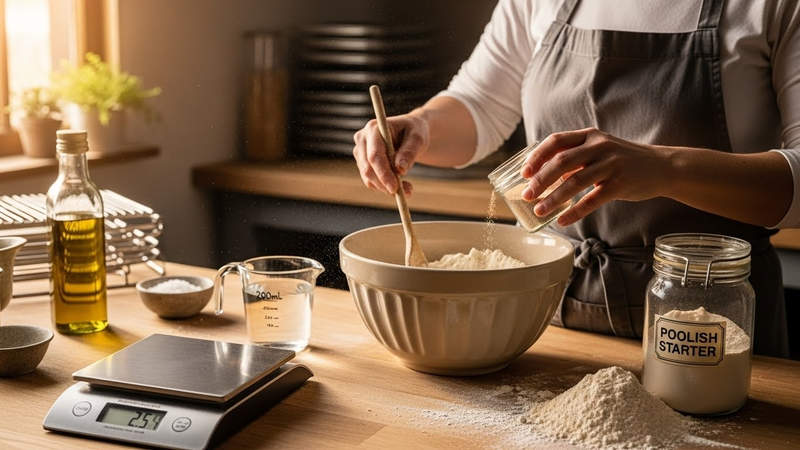
Ever wondered how some breads achieve that ethereal crumb and profound aroma, seemingly effortlessly? The secret often lies in poolish, a liquid pre-ferment that transforms simple flour and water into a powerhouse of flavor and structure.
The Legacy and Essence of Poolish
Poolish, a fluid pre-ferment with the consistency of thick, pourable cream, forms the backbone of many exceptional baked goods. It consists of equal parts flour and water, energized by a minimal quantity of yeast. This technique, introduced by Polish bakers in 19th-century France—hence its name, derived from the French word for “Polish”—quickly garnered acclaim for the remarkable qualities it imparts to dough. The slow, controlled fermentation allows complex flavors to develop, laying a rich aromatic foundation for the final product.
Distinguishing Poolish: A Fermentation Comparison
Poolish stands apart from other pre-ferments due to several defining characteristics:
- Exceptional Hydration: Unlike the stiff, lower-hydration Italian biga, which resembles a firm dough, poolish maintains a consistent 1:1 flour-to-water ratio. This high water content promotes extensive enzymatic activity, leading to a more extensible dough and a lighter, more open crumb structure in the finished bake.
- Subtle Flavor Profile: Compared to the robust, tangy notes of a rye sourdough, poolish offers a gentler, less acidic taste. It contributes a nuanced sweetness and a delicate, yeasty complexity that enhances, rather than dominates, the overall flavor.
- Accelerated Fermentation: Poolish typically matures faster than traditional sourdough starters, reaching its peak activity within 8 to 16 hours. While sourdough relies on a symbiotic culture of wild yeasts and lactic acid bacteria for its distinctive character, poolish utilizes a small, precise amount of baker’s yeast, ensuring predictable results while still cultivating a sophisticated flavor.
Elevating Bakes: Advantages and Foundational Proportions
Incorporating poolish into baking offers a spectrum of benefits, fundamentally enhancing the quality of the final product. The extended fermentation process allows for the creation of new flavor compounds and organic acids, which not only contribute to a deeper aromatic profile but also act as natural preservatives, significantly prolonging the bread’s freshness. This enzymatic breakdown of starches also results in a distinctive, irregular crumb structure, characterized by large, airy pockets that create a light, tender texture. Furthermore, the pre-ferment improves the dough’s elasticity and extensibility, making it supple and easy to handle, a particularly valuable trait for crafting thin, pliable pizza crusts.
A classic poolish adheres to straightforward proportions, ensuring optimal fermentation:
| Ingredient | Proportion |
|---|---|
| Wheat Flour (Type 550-650) | 100% |
| Water (Room Temperature) | 100% |
| Fresh Yeast | 0.1-0.25% |
| Dry Yeast | 0.03-0.08% |
During its 8-16 hour fermentation at room temperature, yeast meticulously metabolizes the simple sugars present in the flour, yielding carbon dioxide, alcohol, and a myriad of aromatic compounds. Concurrently, naturally occurring amylase enzymes within the flour continue to break down complex starches into additional simple sugars, further enriching the flavor profile of the final bake. For home preparation, a simple glass or plastic container with a loose-fitting lid, a precise kitchen scale, and a thermometer to monitor ambient temperature are the only essential tools.
Crafting the Core: A Step-by-Step Poolish Creation
The basic poolish formula
Creating a foundational poolish is a simple yet precise endeavor. Combine 250 grams of wheat flour (ideally type 650) with an equal 250 grams of room-temperature water. Introduce a minimal amount of yeast: 1-2 grams of fresh yeast or 0.5 grams of dry yeast. Stir these ingredients thoroughly until the mixture achieves a uniform, lump-free consistency, resembling a smooth, thick batter. Cover the container loosely with cling film, puncturing a small vent to allow gases to escape while preventing the surface from drying out.
The optimal fermentation window, typically 12-16 hours, occurs within a temperature range of 21-24°C (70-75°F). As the yeast actively consumes sugars, the poolish will visibly transform: small, persistent bubbles will begin to pepper the surface, gradually multiplying and coalescing. The mixture will swell, often doubling in volume, and its texture will become noticeably aerated and lively. A well-fermented poolish will possess a subtly sweet, yeasty aroma and a delicate, shimmering network of bubbles, signaling its readiness to imbue your dough with depth and character. The critical element for success lies in maintaining the precise 1:1 flour-to-water ratio and using a sparing amount of yeast, which orchestrates a slow, deliberate fermentation, allowing the full spectrum of complex aromas to unfurl.
Integrating Poolish into Diverse Doughs
Wheat bread: structure and development
For a wheat bread boasting a complex flavor and open crumb, combine a mature poolish (representing 100% of the pre-ferment in the recipe) with an additional 400 grams of flour, 200 grams of water, 10 grams of salt, and an optional 2 grams of yeast if a slightly faster rise is desired. After thoroughly mixing the ingredients until just combined, allow the dough to rest for 30 minutes—a crucial autolyse period that permits the flour to fully hydrate and gluten to begin developing without mechanical stress. Following this, perform a series of gentle folds every 30 minutes over a two-hour period; this builds strength and elasticity in the dough, transforming it from a shaggy mass into a smooth, cohesive structure. Once adequately developed, shape the dough and allow it a final proof for 1-2 hours until it feels light and airy, then bake at 230°C (450°F) until golden brown and hollow-sounding.
Neapolitan pizza: achieving airy perfection
Neapolitan pizza dough, when enriched with poolish, develops an exceptional lightness and a signature airy, blistered crust. For 500 grams of high-quality type 00 flour, incorporate 200 grams of active poolish, 300 grams of water, 15 grams of fine salt, and 5 grams of olive oil. After kneading until the dough is smooth and elastic, allow it to rest at room temperature for 2 hours. This initial period permits the yeast to become active and gluten to relax. Subsequently, transfer the dough to the refrigerator for a prolonged cold fermentation of 24-48 hours. This extended chill slows yeast activity, allowing enzymes to break down starches into sugars, intensifying flavor development and creating a more digestible crust. Before shaping, remove the dough from the refrigerator and let it temper at room temperature for approximately 2 hours, ensuring it becomes pliable and easy to stretch into delicate, thin rounds.
Navigating Common Pitfalls and Optimizing Poolish Use
Avoiding fermentation missteps
Working with poolish, while rewarding, presents a few common challenges. Allowing the poolish to ferment for too long can lead to over-acidification, resulting in a sour flavor and a weakened gluten structure in the final dough. Conversely, using an excessive amount of yeast accelerates the fermentation process, which can compromise the development of complex flavors and aromas, leading to a less nuanced bake. Furthermore, incorrect proportions in the final dough, or an insufficient resting period after the poolish has been incorporated, can hinder proper gluten development and result in a dense, less desirable texture.
Extending poolish vitality and flavor horizons
To manage fermentation speed and extend the utility of your poolish, it can be stored in the refrigerator for up to 3 days. The cooler temperatures significantly slow yeast activity, preserving its potency. Before integrating refrigerated poolish into a dough, allow it to return to room temperature for about an hour; this reawakens the yeast and ensures consistent activity. For those seeking to broaden the aromatic complexity of their bakes, consider modifying the basic poolish recipe by substituting 5-10% of the wheat flour with rye or spelt flour. These alternative grains introduce distinct earthy and nutty notes, further enriching the flavor profile of the finished bread.