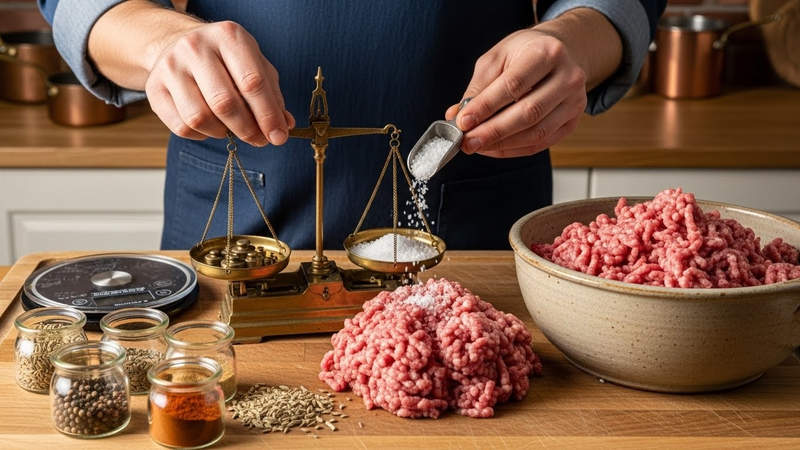
Why does a perfectly cured sausage boast such depth of flavor and a reassuringly firm bite, while others fall flat or spoil prematurely? The answer lies in the precise, often underestimated, power of salt.
Optimal salting ratios for foundational flavor and preservation
Achieving a truly exceptional homemade sausage begins with the fundamental science of salting. An optimal salt concentration of 18-20 grams per kilogram of meat—translating to approximately 1.8-2% of the total mass—serves as the cornerstone. This precise proportion doesn’t merely season; it orchestrates a complex interplay of chemical and biological processes. Salt actively inhibits the proliferation of undesirable bacteria, creating an environment where beneficial fermentative microorganisms can thrive, contributing to the sausage’s nuanced flavor development and extended shelf life.
Insufficient salt, below 15g/kg, risks rapid spoilage, compromising both safety and culinary effort. Conversely, exceeding 25g/kg can overpower the delicate meat flavors, yielding an unpleasantly saline product.
The nuanced influence of salt varieties
The choice of salt subtly shapes the final sensory profile of homemade sausage. Each type imparts its own signature:
- Rock salt delivers a clean, assertive salinity that allows the inherent meat flavors to shine.
- Sea salt introduces delicate, oceanic mineral notes, adding a layer of complexity.
- Himalayan pink salt contributes a subtle sweetness and a spectrum of trace minerals, enriching the overall taste experience.
For sausages destined for extended curing and fermentation, selecting salts free from anti-caking agents is paramount. These additives can interfere with the natural microbial processes crucial for proper maturation, potentially hindering the development of desired textures and flavors.
Practical home measurement methods
When a precise digital scale isn’t at hand, common kitchen tools offer reliable approximations for salting. A level tablespoon of standard kitchen salt typically weighs between 15-18 grams. This means for a kilogram of meat, slightly more than one level tablespoon will achieve the desired range. Alternatively, a level teaspoon holds approximately 5-6 grams of salt, requiring 3-4 such teaspoons per kilogram of meat to reach the optimal concentration. These methods, while less precise than digital weighing, provide a practical pathway to consistent results for the home cook.
Salt’s critical role in microbiological safety
Beyond flavor, salt is a formidable guardian of food safety in sausage making. Its presence initiates several protective mechanisms:
- Water activity reduction: Salt draws moisture from the meat cells, effectively lowering the water activity (aw). This creates an inhospitable environment for most pathogenic bacteria, which require higher water activity levels to grow and reproduce.
- Protein extraction and textural enhancement: Salt facilitates the extraction of myofibrillar proteins from the meat. These proteins, when mixed, form a cohesive matrix that binds the sausage components together, contributing to a desirable, firm texture and preventing crumbling during cooking or slicing.
- Synergistic preservation: Salt amplifies the efficacy of other antimicrobial agents, such as nitrites in curing salts and naturally occurring antibacterial compounds found in various spices, forming a robust defense against spoilage.
Factors influencing salt levels
The optimal salt concentration is not a static figure; it dynamically shifts based on the sausage’s intended preparation and curing duration.
Tailoring salt levels to sausage type
Different sausage styles demand distinct salt ratios to achieve their characteristic textures, flavors, and shelf stability.
| Sausage Type | Recommended Salt Range (g/kg meat) | Rationale |
|---|---|---|
| Raw | 18-22 | Higher concentration supports crucial microbial fermentation during prolonged curing, fostering complex flavors and ensuring long-term preservation. |
| Scalded | 16-18 | Thermal processing provides primary preservation, allowing for a slightly lower salt content while maintaining safety and a succulent, tender texture. |
| Smoked | 15-20 | Smoking itself imparts significant antimicrobial properties. Lower salt levels (15-17g/kg) are suitable for intensely smoked varieties, where the smoke contributes heavily to preservation and flavor, while higher levels (18-20g/kg) are used for lighter smoking. |
For sausages undergoing extended curing—beyond three weeks—a slight reduction in salt to 16-18 g/kg is often feasible. The prolonged fermentation process naturally enhances preservation, allowing for a less saline final product without compromising safety.
The impact of additives and distribution techniques
The perceived saltiness of a sausage is not solely dictated by the amount of sodium chloride; it’s profoundly influenced by other aromatic additions and the meticulousness of salt distribution.
- Garlic (3-5 g/kg) intensifies the perception of saltiness, allowing for a potential slight reduction in actual salt.
- Black pepper (1-2 g/kg) also enhances the savory notes, contributing to a more pronounced salty sensation.
- Conversely, marjoram (2-3 g/kg) and caraway (1-2 g/kg) can mellow the salty impression, potentially enabling a salt reduction of up to 10% without diminishing flavor satisfaction.
Achieving a homogenous distribution of salt throughout the meat mixture is paramount for consistent flavor and effective preservation. Several techniques ensure this:
- Two-stage method: Half the salt is incorporated during the initial mixing, with the remaining half added after a 12-24 hour resting period. This allows for deeper penetration and more even absorption into the meat fibers.
- Brine technique: A 10% salt solution is prepared and introduced to the meat instead of dry salt. This method ensures uniform dispersion, particularly beneficial for larger batches or specific sausage types.
- Vacuum massaging: While primarily an industrial technique, it significantly reduces the amount of salt required by 5-8% due to enhanced penetration and protein extraction under vacuum, yielding a consistent texture and flavor profile.
Modern approaches to salt reduction often involve innovative ingredients. Potassium chloride can substitute up to 30% of sodium chloride, offering a similar salty taste with reduced sodium. Yeast extracts and protein hydrolysates act as flavor enhancers, intensifying the savory notes and allowing for a lower overall salt content without sacrificing taste. Furthermore, low-sodium salt enriched with magnesium offers a pathway to a 25% reduction in sodium, maintaining the characteristic salty profile.
Calculating curing salt for precise results
When incorporating curing salts (often referred to as pink salt or Prague powder), a meticulous calculation is essential to prevent over-salting. Standard curing salt formulations typically comprise 99.4-99.6% sodium chloride and 0.4-0.6% sodium nitrite. If a recipe calls for 25 g of curing salt per kilogram of meat, the actual sodium chloride contribution is approximately 24.9 g. This inherent salt content must be factored into the overall recipe to ensure the final product achieves the desired salinity without becoming excessively salty, preserving both flavor balance and the integrity of the curing process.