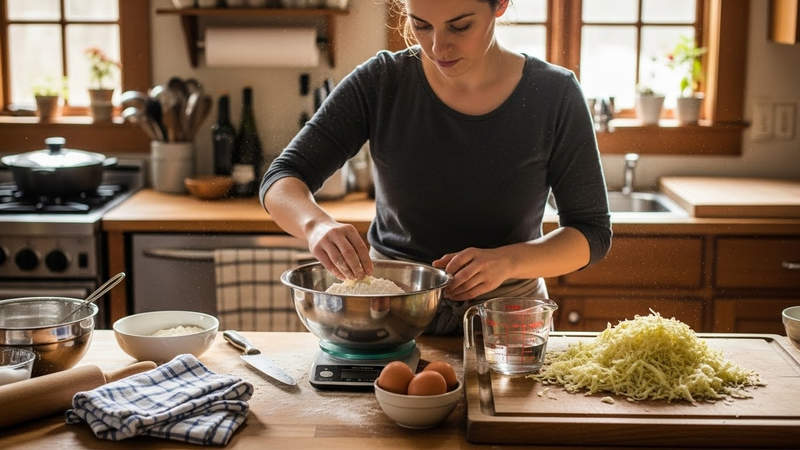
What separates a truly sublime pierog from a merely good one? It often begins with the dough—a delicate, yet resilient embrace for its savory or sweet core.
The Foundation: Dough Proportions for Resilient Pierogi
Achieving the ideal pierogi dough, supple enough to stretch without tearing and robust enough to cradle a generous filling, hinges on precise ingredient ratios. For a batch of 100 pierogi, the following balance ensures optimal elasticity and workability:
| Ingredient | Quantity (Metric) | Quantity (Imperial Approx.) | Purpose |
|---|---|---|---|
| Wheat Flour (Type 500) | 1 kg | 8 cups | Provides structure; Type 500 offers a balanced protein content for elasticity without excessive chewiness. |
| Eggs | 2-3 (120-180 g) | 2-3 large | Contributes richness, color, and additional binding strength, preventing the dough from becoming crumbly. |
| Warm Water | 450-500 ml | 1.9-2.1 cups | Activates gluten, creating a pliable dough. Warmth (around 40-45°C) aids in faster hydration and a smoother texture. |
| Oil | 2-3 tbsp (30-45 ml) | 2-3 tbsp | Imparts tenderness and prevents sticking, making the dough easier to roll and more resistant to tearing during cooking. |
| Salt | 10 g | 2 tsp (level) | Enhances flavor and tightens gluten structure, contributing to the dough’s overall strength and resilience. |
This combination yields approximately 1.6-1.7 kg of dough, translating to about 16-17 grams of dough per pierog. Rolling the dough to a thickness of 2-3 mm is crucial; a thinner sheet risks tearing, while a thicker one results in a dense, less refined texture after cooking. The dough should possess a velvety smoothness and a yielding resistance when pressed, indicating its readiness for shaping.
The Heart: Calculating Cabbage Filling Quantities
The soul of a pierog often lies in its filling, and for cabbage varieties, managing moisture and flavor is paramount. Different cabbage types undergo varying degrees of volume reduction during cooking, necessitating adjusted starting quantities to achieve the desired 1.5-1.8 kg of finished filling for 100 pierogi, with each dumpling holding 15-18 grams of its savory core.
White cabbage for a delicate filling
White cabbage yields a denser, milder filling.
- Raw Quantity: 2.5-3 kg
- Yield (after cooking): 1.5-1.8 kg
- Dough:Filling Ratio: Approximately 1:1 or 1:0.9
White cabbage loses around 40% of its volume during thermal processing, compacting into a cohesive mass with a subtle sweetness.
Sauerkraut for a tangy profile
Sauerkraut delivers a vibrant, acidic punch and requires less initial volume due to its pre-processed state.
- Raw Quantity: 2-2.5 kg
- Yield (after cooking): 1.4-1.6 kg
- Dough:Filling Ratio: Approximately 1:0.8
Sauerkraut typically reduces by about 30% in volume. Its inherent tanginess means less seasoning is often needed, and careful draining is essential to prevent a watery filling that could compromise the pierog’s structural integrity.
Napa cabbage for a lighter texture
Napa cabbage creates a softer, lighter filling, but its high water content demands a larger initial quantity.
- Raw Quantity: 3-3.5 kg
- Yield (after cooking): 1.5-1.8 kg (estimated for 100 pierogi)
- Dough:Filling Ratio: Approximately 1:0.7
Napa cabbage can lose up to 60% of its volume due to its high moisture content. Its delicate flavor pairs well with subtle seasonings, but thorough pressing and draining after cooking are vital to avoid a soggy filling.
The varying water content and structural differences between cabbage types directly influence the final texture and density of the filling. White cabbage provides a firm, traditional consistency, while sauerkraut offers a distinct chew and bright acidity. Napa cabbage results in a more ethereal, tender filling. Regardless of the type, finely chopping or even grinding the cooked cabbage ensures a uniform texture that packs neatly into the dough, preventing air pockets and ensuring even distribution of flavor. Sautéing 300-400g of finely diced onion until translucent before combining it with the cabbage adds a foundational layer of aromatic sweetness that enriches any cabbage filling.
Practical Strategies for Large-Scale Pierogi Production
Preparing 100 pierogi is a culinary marathon, not a sprint. Strategic planning and execution transform a daunting task into a satisfying one.
Dough preparation nuances for substantial quantities
When handling larger volumes of dough, traditional kneading methods can become cumbersome. Instead of attempting to work a single, massive dough ball, divide the flour into smaller portions, ideally around 300-350 grams each. This approach allows for more efficient gluten development, resulting in a consistently smooth and elastic dough. A planetary mixer equipped with a dough hook proves invaluable for larger batches, effortlessly developing the gluten network that gives pierogi their characteristic chew.
Introducing water at a temperature of 40-45°C (104-113°F) significantly aids in gluten activation and hydration, creating a more pliable dough that is less prone to tearing during rolling and shaping. Once kneaded, the dough requires a minimum 30-minute rest, covered to prevent a dry skin from forming. This resting period allows the gluten strands to relax, making the dough much easier to roll out thinly and uniformly. The finished dough should feel soft and yielding to the touch, yet firm enough not to stick to your hands. Overly stiff dough will resist rolling and likely crack during boiling, while excessively soft dough becomes unmanageable during assembly. For efficient rolling of a large batch, divide the rested dough into 4-5 smaller balls, working with one at a time while keeping the others covered with a damp cloth to maintain their moisture and pliability.
Filling methods and workflow organization
Efficiently processing the substantial quantity of cabbage required for 100 pierogi begins with careful preparation. Fresh white cabbage benefits from a brief blanching—3-4 minutes in salted boiling water—to soften its texture and reduce its volume, followed by thorough draining to eliminate excess moisture. Sauerkraut, conversely, often requires firm squeezing to remove brine, and a quick rinse if its acidity is overwhelmingly sharp. After initial processing, finely chop the cabbage, then sauté it gently in clarified butter with the aromatic addition of finely diced onion until both are tender and fragrant. This step not only builds flavor but also further reduces moisture. Season the cooled filling with freshly ground black pepper, marjoram, and caraway to complement the cabbage’s natural flavors, allowing the mixture to cool completely before assembly. A warm filling can cause the dough to become sticky and difficult to work with.
Organizing the workspace streamlines the assembly process. Designate a large, flour-dusted surface for rolling and shaping. Position bowls of prepared filling within easy reach. Employing a pierog cutter, typically 8-10 cm in diameter, ensures uniformity in size and shape, leading to consistent cooking times. A “production line” approach often proves most effective: one person rolls and cuts the dough circles, while another meticulously fills and seals each pierog, creating a rhythmic flow that accelerates the process.
Efficient storage of assembled pierogi
After the meticulous work of assembly, proper storage preserves the quality of your handcrafted pierogi. Arrange freshly formed pierogi in a single layer on baking trays lined with parchment paper, ensuring they do not touch. This initial separation prevents them from freezing together into an unmanageable block. Transfer the trays to the freezer for 2-3 hours, allowing the pierogi to firm up completely. Once individually frozen, they can be transferred to airtight freezer bags. Label each bag clearly with the preparation date; properly frozen pierogi maintain their peak quality for up to three months. Portioning them into smaller bags, containing 15-20 pierogi each, simplifies future meal preparation.
When it’s time to enjoy your frozen pierogi, there is no need to thaw them. Drop the frozen dumplings directly into a pot of vigorously boiling, salted water. They will float to the surface as they cook, signaling their readiness. Continue to boil them for an additional 3-4 minutes after they rise, ensuring the filling is heated through and the dough is perfectly tender, yet still possessing a satisfying chew. This direct-to-boil method prevents the dough from becoming waterlogged and maintains the pierog’s structural integrity.