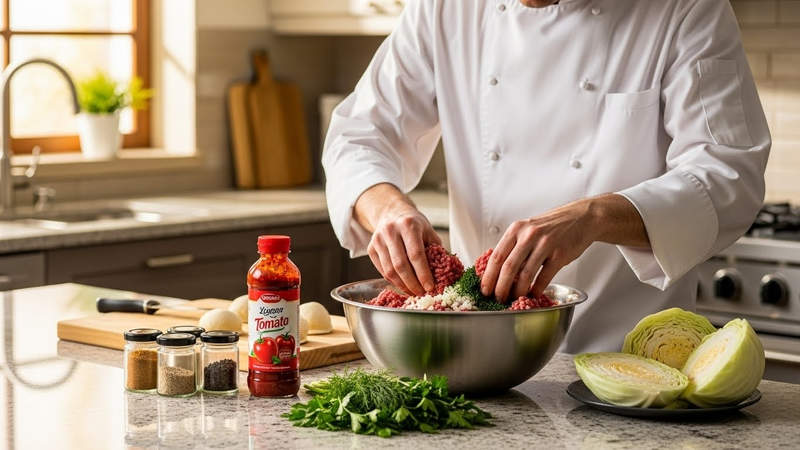
Why do some cabbage rolls emerge from the pot dry and dense, while others offer a tender, succulent embrace with every bite? The answer lies not in magic, but in meticulous ingredient selection and precise technique.
The foundation of flavor: ingredient selection and balance
Meat and rice: the core of a succulent filling
The cornerstone of a truly juicy cabbage roll filling begins with its primary components. Insufficient fat within the mixture is a primary culprit behind a dry final product. Fat is crucial for both flavor and texture; it renders during cooking, lubricating the protein fibers and preventing them from becoming overly tight and dry. A well-balanced filling incorporates meat with a natural fat content, or additional elements to enhance moisture. For optimal richness, a blend of ground pork and beef is ideal, with a ratio of approximately 60% meat to 30% rice and 10% other additions.
Rice, the essential binder and moisture absorber, plays a pivotal role. It must be par-cooked, not fully cooked, before being incorporated into the filling. This partial cooking allows the rice grains to swell slightly, preparing them to absorb the flavorful cooking liquids during the long simmering process. This absorption is key; the rice acts as a moisture reservoir, expanding gently within the roll and preventing the filling from becoming dense and compacted.
Enhancing moisture and depth: aromatic additions
Beyond the core meat and rice, specific additions significantly amplify the filling’s succulence and flavor complexity. Finely diced onion, at least one large onion for every 500g of meat, releases its moisture during cooking, integrating seamlessly into the filling. Grated carrots introduce both additional moisture and a subtle, natural sweetness that complements the savory elements. Further enriching the texture and preventing dryness, a tablespoon of butter or two tablespoons of oil should be added for every 500g of filling.
For an even more pronounced juiciness, incorporating 100g of finely diced bacon or pork belly provides rendered fat that creates a richer mouthfeel and acts as a protective barrier against moisture loss. Seasoning the filling demands balance, extending beyond salt and pepper. Marjoram, about one teaspoon per 500g of meat, adds a warm, earthy note. Ground caraway, half a teaspoon, contributes a subtle, distinctive aroma, while two to three cloves of minced garlic infuse pungent depth. These aromatics don’t merely flavor; they build layers of sensory experience.
The enveloping leaf: cabbage selection and preparation
Selecting the perfect cabbage head
The quality of the cabbage profoundly influences the final texture and ease of preparation. An overly mature cabbage tends to be tough and fibrous, resisting tenderization. Conversely, a very young cabbage might possess leaves too delicate, prone to tearing and disintegration during cooking. The ideal choice is a medium-sized head, characterized by firm yet flexible leaves with a vibrant green hue. These leaves possess the necessary resilience for rolling while offering a tender finish after cooking.
Tenderizing the leaves: the art of blanching
Proper preparation of the cabbage leaves is a critical step. Blanching softens the cellulose in the leaves, making them pliable enough to roll without cracking or tearing, while preserving their structural integrity. The most effective method involves coring the cabbage head and then submerging the entire head in a large pot of salted boiling water for 10 to 15 minutes. The salt in the water subtly seasons the leaves from within. As the outer leaves soften, they can be carefully peeled away, one by one. Over-blanching is a common pitfall; it renders the leaves too soft and fragile, making them difficult to handle and prone to tearing. The leaves should feel supple, not limp. For a delicate alternative, Savoy cabbage requires a shorter blanching time, typically 5 to 7 minutes, imparting a milder flavor. Young cabbage leaves are naturally thinner but demand more careful handling due to their fragility.
Refining the leaves: thinning the veins
A frequent oversight that leads to unevenly cooked cabbage rolls is neglecting the thick veins within the leaves. These prominent veins create resistance during the rolling process and remain tough even after extended cooking, resulting in an inconsistent texture. To ensure uniform cooking and a cohesive roll, the thickest parts of these veins must be carefully thinned with a knife, running parallel to the vein itself, without cutting through the entire leaf. This technique allows the entire surface of the leaf to achieve a similar thickness, ensuring a tender, even bite throughout the finished roll.
Assembling and simmering: the craft of the cabbage roll
The art of wrapping: achieving structural integrity
The technique employed for wrapping cabbage rolls directly dictates their final texture. A roll that is too tightly compressed prevents the rice from expanding properly, leading to a hard, dense filling. Conversely, a roll wrapped too loosely risks the filling spilling out during the cooking process. The goal is a harmonious balance: a compact roll that remains firm but not constricted. This allows the rice sufficient space to absorb liquids and swell, contributing to the roll’s tender interior.
The proportion of filling to cabbage leaf is also significant. A cabbage-dominant roll will often result in a drier product. An optimal ratio typically involves two-thirds filling to one-third cabbage leaf. The filling itself should be spread evenly across the leaf’s surface to ensure consistent cooking and flavor distribution in every bite.
The wrapping process is a sequence of precise movements:
- Position approximately two tablespoons of filling onto the lower portion of a prepared cabbage leaf.
- Fold the sides of the leaf inward over the filling.
- Roll the leaf from the bottom upward, maintaining a snug yet gentle tension, avoiding excessive squeezing.
- Tuck the final edge of the leaf underneath the roll to secure it.
The slow simmer: infusing moisture and tenderness
The temperature and duration of cooking are paramount to achieving succulent cabbage rolls. High, aggressive heat rapidly evaporates moisture, leading to dry results. The most effective method involves a slow, gentle simmer over low heat for 1.5 to 2 hours. This extended, low-temperature cooking allows the tough collagen in the meat and the cellulose in the cabbage to gradually break down, transforming them into a melt-in-your-mouth texture.
During simmering, the cabbage rolls must be partially submerged in a flavorful liquid, typically a tomato sauce, vegetable broth, or meat broth, reaching at least halfway up their height. This braising liquid continuously infuses moisture and flavor into the rolls. To further enhance moisture retention, the cooking vessel should be covered. Placing a layer of aluminum foil directly over the rolls before adding the lid creates a self-basting environment, trapping steam and ensuring that the uppermost rolls remain hydrated and do not dry out. The sauce should maintain a gentle, consistent simmer, never a vigorous boil, allowing the flavors to meld and the textures to soften gradually. Replenishing the liquid as needed throughout the simmering process is crucial to prevent drying, ensuring the rolls remain bathed in their flavorful, aromatic bath.