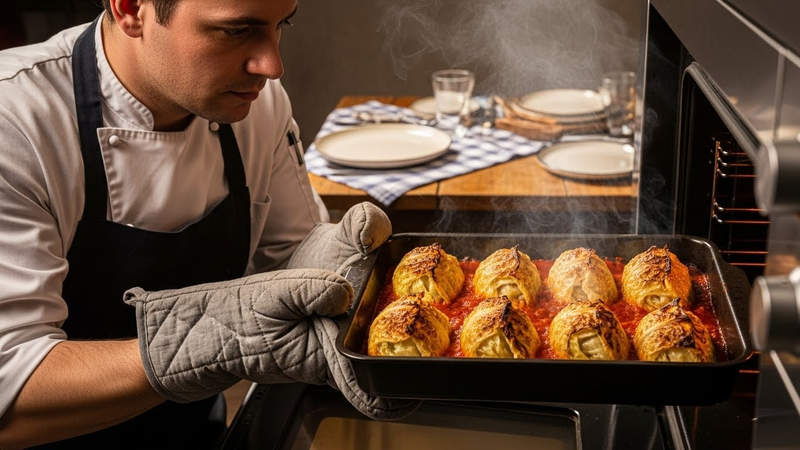
What secret transforms humble cabbage and filling into a dish of profound comfort, where every bite offers a symphony of tender textures and deep, savory flavors? The answer lies in precise thermal control and an understanding of how heat interacts with each component, ensuring the filling cooks thoroughly while the cabbage leaves achieve a yielding softness without disintegrating.
Optimal thermal parameters for gołąbki
Achieving perfectly baked gołąbki hinges on maintaining a core temperature range of 180-200°C (350-390°F). This thermal sweet spot facilitates an even heat transfer throughout the dish, allowing the interior to cook completely without scorching the delicate outer cabbage leaves. Temperatures below 170°C (340°F) prolong the cooking process excessively, leading to a loss of vibrant flavor and a less desirable, mushy texture. Conversely, exceeding 210°C (410°F) risks prematurely browning or even burning the cabbage exterior, leaving the filling undercooked and the dish unbalanced.
Calibrating baking duration by gołąbki size
The time required for gołąbki to reach their peak tenderness directly correlates with their mass and density. Larger, more substantial rolls demand a longer exposure to heat to ensure the internal filling is thoroughly cooked and the cabbage leaves are uniformly tender.
| Gołąbki Size | Approximate Weight | Baking Time at 180-200°C |
|---|---|---|
| Small | 80-100g | Approximately 60 minutes |
| Medium | 120-150g | Approximately 75 minutes |
| Large | Over 150g | 85-90 minutes |
The role of covered baking in moisture retention
For the initial phase of baking, typically the first 45-60 minutes, gołąbki thrive when covered. This technique creates a self-steaming environment within the baking vessel, trapping precious moisture and promoting a uniform heat distribution. The enclosed steam gently permeates the cabbage leaves, rendering them supple and tender, while ensuring the filling remains incredibly juicy and succulent. This method prevents the outer layers from drying out prematurely, allowing the interior to cook at an unhurried pace.
Unveiling for a golden finish and flavor depth
After the initial covered period, removing the lid for the final 15-20 minutes of baking transforms the dish. This exposure to direct oven heat encourages surface evaporation and initiates the Maillard reaction, developing an appealing, subtly caramelized golden hue on the cabbage leaves. If a tomato-based sauce bathes the gołąbki, this uncovered interval allows the sauce to gently reduce and concentrate, intensifying its savory depth and creating a richer, more viscous consistency that clings beautifully to each roll.
Assessing doneness for perfect texture
To confirm the gołąbki have reached their ideal state, a simple test suffices. Gently pierce one with a fork or a thin skewer; it should glide through the cabbage and filling with minimal resistance, indicating a tender, yielding texture. For gołąbki containing meat, verify that the interior is cooked through, with no pinkness remaining. If rice is part of the filling, ensure it has fully softened and absorbed all available moisture, transforming into a creamy, comforting component.
Influential factors shaping gołąbki baking
Beyond basic temperature and time, several nuanced elements profoundly impact the final character of baked gołąbki. Understanding these variables allows for precise adjustments, guaranteeing a consistently exquisite result.
Filling composition and cabbage leaf preparation
The core ingredients of the filling dictate its thermal requirements. Meat-based fillings necessitate a longer cooking duration, typically 60-75 minutes at 180°C (350°F), to ensure the protein is safely cooked and tender. In contrast, vegetarian gołąbki, often featuring rice and vegetables, require a shorter bake of approximately 45-55 minutes, as their components cook more rapidly. Gołąbki prepared with buckwheat groats fall in between, needing around 50-60 minutes for the groats to fully soften and develop their characteristic nutty flavor.
The preparation of the cabbage leaves is equally critical. Properly blanched leaves become remarkably pliable and easy to roll, but crucially, this process also softens their cellular structure, reducing the overall baking time by approximately 15-20 minutes. Unblanched leaves, retaining their rigid structure, demand significantly longer cooking, which can risk overcooking and drying out the delicate filling.
Dishware material and oven technology considerations
The vessel chosen for baking gołąbki plays a significant role in heat distribution and moisture retention. Different materials interact with heat in distinct ways, necessitating slight temperature or time adjustments.
| Dishware Material | Heat Properties | Recommended Use & Temperature |
|---|---|---|
| Ceramic | Excellent for even heat distribution, retains moisture | Ideal for slow, gentle baking; 170-180°C (340-355°F) |
| Glass | Heats slowly but maintains stable temperature | Best for prolonged, steady cooking; 160-170°C (320-340°F) |
| Metal | Conducts heat most rapidly, promotes quicker cooking | Shortens baking time by ~10 minutes; requires frequent basting |
The type of oven also demands specific parameter adjustments to achieve optimal results. Each oven technology employs different heat transfer mechanisms, influencing how gołąbki cook.
| Oven Type | Temperature Adjustment | Time Adjustment | Rationale |
|---|---|---|---|
| Convection | Lower by 15-20°C (160-165°C / 320-330°F) | Shorter by ~10-15 minutes | Circulating hot air cooks faster and more evenly, but can dry surfaces |
| Gas | Higher by 10-20°C (190-200°C / 375-390°F) | Standard or slightly longer | Often has less even heat distribution, requiring higher temperatures to compensate for cooler spots |
| Electric (Static) | Standard (180°C / 350°F) | Standard (60-75 minutes) | Most predictable and consistent heat distribution, serving as the baseline for recipes |
The strategic art of basting and moisture management
Regular basting throughout the baking process is a simple yet powerful technique to maintain the gołąbki’s luscious juiciness and infuse them with additional flavor. Drizzling them with tomato sauce or broth every 15-20 minutes prevents the exposed surfaces from drying out and allows the flavors to meld deeply. For convection ovens, which excel at browning but can accelerate moisture loss, a strategic approach involves covering the baking dish with aluminum foil for the initial 30 minutes. This creates a humid microclimate, protecting the gołąbki from excessive drying, before uncovering them to achieve that desirable, lightly browned surface.